





Mission Statement

Located in the Chemical Engineering Department at the University of Engineering & Technology, Kala Shah Kaku Campus, the Shamim Irshad High Performance Computing Center (SIHPCC) was established in 2024 to advance knowledge and innovation in the areas of Artificial Intelligence, Engineering  Modeling & Simulation, as well as other research domains that require high-performance computing capabilities. 

Our mission focuses on:

People: Developing expertise in the field of Artificial Intelligence and Engineering Modeling & Simulation 

Knowledge: Connecting globally with experts to provide students with top-tier learning opportunities through seminars and workshops.

Projects: Equipping students with advanced hardware and software for innovative projects, driving research and technological excellence.

Webinar: AI made Simple for ALL

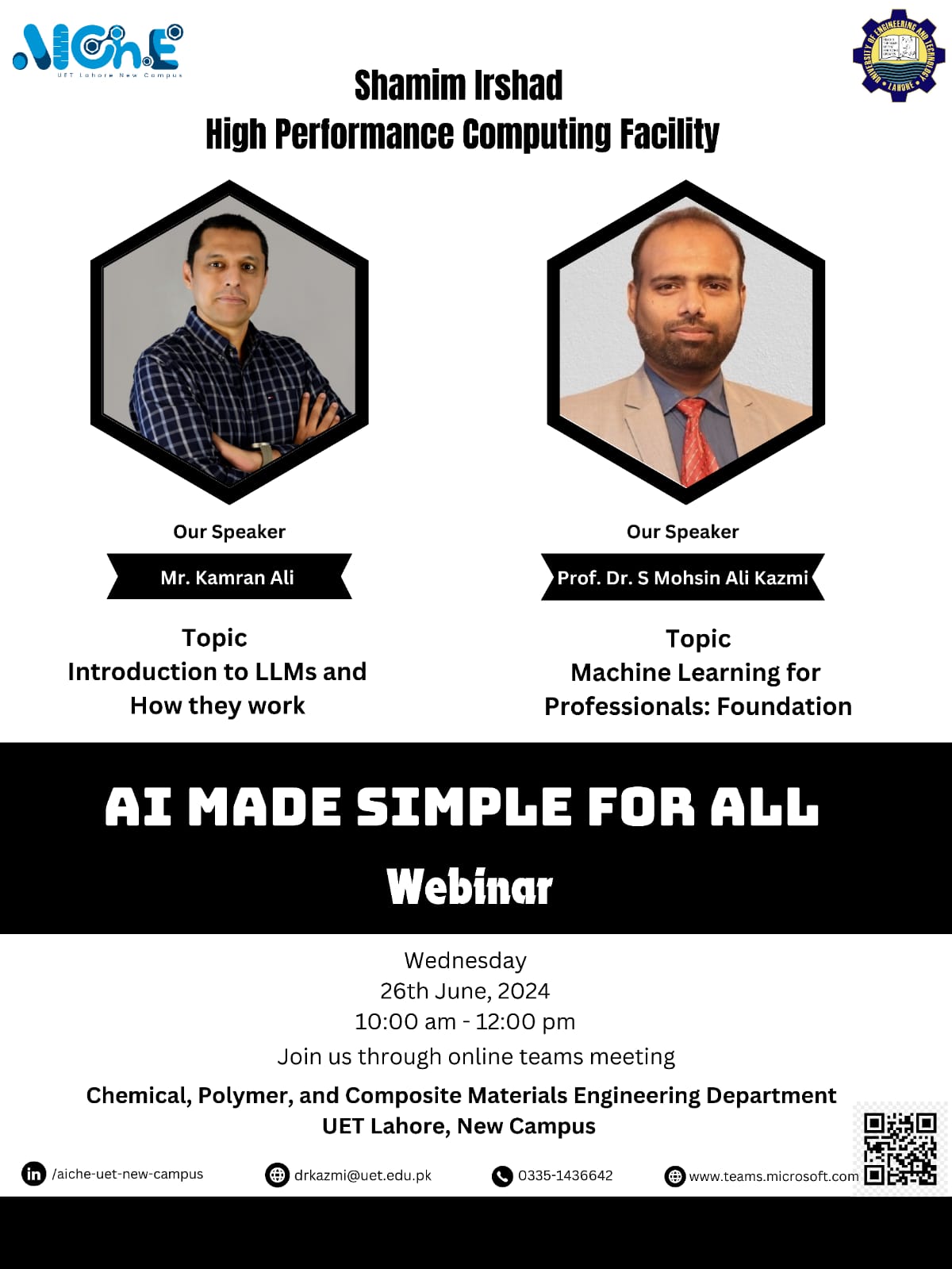
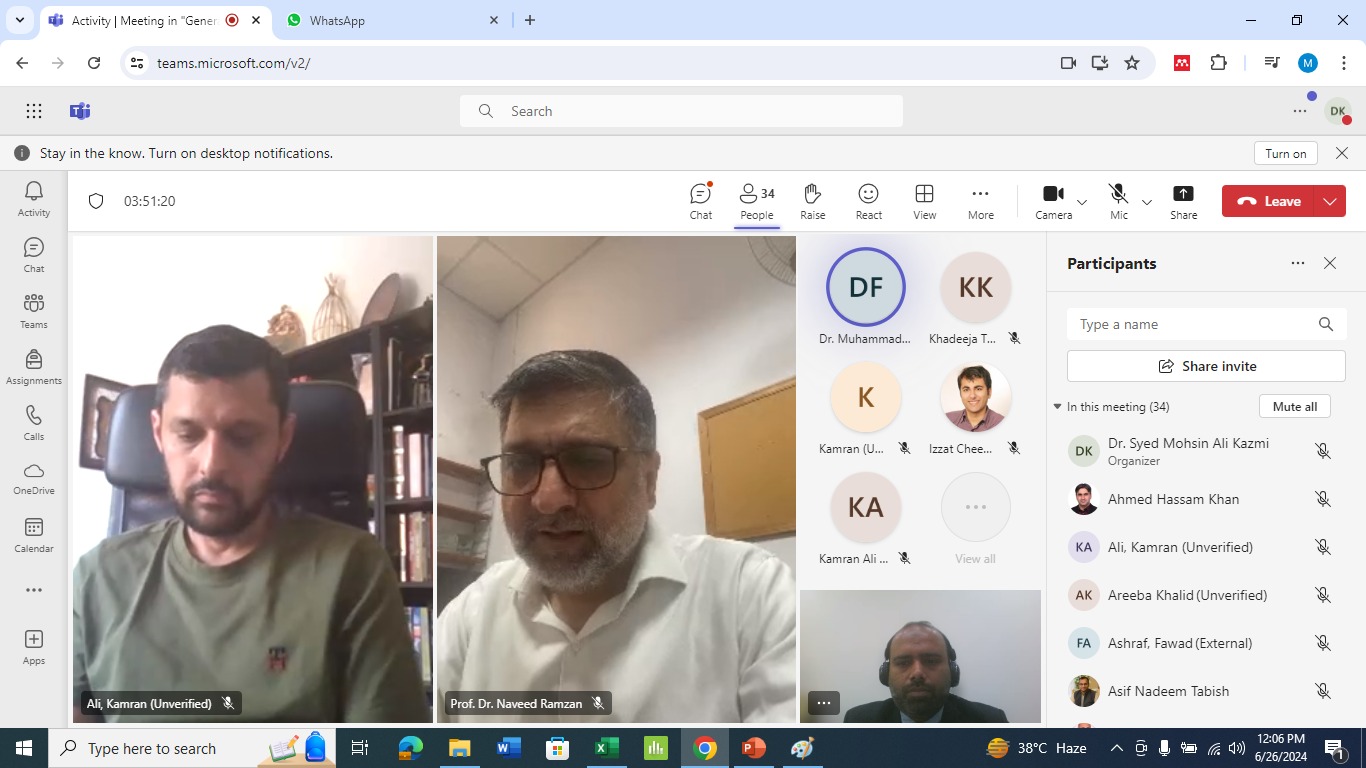
SIHPCC organized a webinar titled “AI Made Simple for ALL,” hosted by the esteemed Prof. S. Mohsin Ali Kazmi and the renowned AI expert, Mr. Kamran Ali. The event took place on 26-June-2024 and was a resounding success, drawing a diverse audience eager to understand artificial intelligence.

Event Highlights:

During the webinar, Prof. S. M. Ali Kazmi and Mr. Kamran Ali delivered an engaging and insightful presentation that covered a range of topics designed to provide a comprehensive introduction to AI. The key highlights of the session included:

  • Understanding Machine Learning and Generative AI: Prof. S. M. Ali Kazmi and Mr. Kamran Ali broke down complex AI concepts into simple, easy-to-understand terms, making it accessible for everyone, regardless of their technical background.
  • Real-World Applications: The hosts explored how AI is being utilized in various sectors such as healthcare, finance, and education, providing real-world examples and case studies to illustrate the impact of AI on everyday life.
  • Interactive Q&A: Participants had the opportunity to ask questions and engage directly with the hosts, making for an interactive and dynamic session.
  • Future of Machine Learning and Generative AI: Insights into emerging trends and the future potential of AI technologies such as generative AI were shared, sparking curiosity and inspiration among the attendees.

The webinar successfully conveyed the message that AI is not just for tech experts but for everyone. Prof. S. M. Kazmi and Mr. Kamran Ali’s approachable and clear explanations helped demystify AI, encouraging participants to explore and understand its vast possibilities. The response from participants was overwhelmingly positive. Attendees appreciated the clarity and depth of the content, as well as the interactive nature of the session. Many expressed that they felt more confident in their understanding of AI and inspired to learn more about its applications.

Stay tuned for more informative sessions and updates on upcoming events. SIHPCC extend it’s heartfelt thanks to Prof. S. M. Ali Kazmi and Mr. Kamran Ali for hosting such an enlightening webinar and to all the participants for making it a success. Together, we are making AI simple and accessible for all!

Inauguration Ceremony of Shamim Irshad – High Performance Computing CENTER at UET Lahore

The inauguration ceremony of Shamim Irshad – High Performance Computing center funded by Engr. Kamran Ali (Alumnus – 1994, Chemical Engineering, UET Lahore) held at Department of Chemical, Polymer and Composite Materials Engineering, University of Engineering and Technology, Lahore (New Campus). Dean Faculty of Chemical, Polymer & Metallurgical Engineering Prof. Dr. Naveed Ramzan along with Chairperson Chemical, Polymer and Composite Materials Engineering Department Prof. Dr. S. Mohsin Ali Kazmi, Group Lead Computer Aided Design Dr. Izzat Iqbal Cheema (Associate Professor) and Dr. Zohaib Atiq Khan (Assistant Professor) inaugurated the facility.

The Shamim Irshad – High Performance Computing Facility is established to advance knowledge and innovation in arears of Artificial Intelligence, Engineering Modelling ad Simulation, as well as other research domains that require high performance computing capabilities. The motto behind this facility is to “empowering innovation through advanced computing and collaborative expertise”. Chairpersons and faculty members of various departments from Main and New Campuses attended the ceremony.

Article: Beyond ALOHA- Quickly predict accidental release of toxic chemicals using machine learning

SIHPCC is pleased to announce the publication of latest research paper titled:

“Beyond ALOHA – Quickly Predict Accidental Release of Toxic Chemicals Using Machine Learning”

https://doi.org/10.1016/j.jlp.2024.105542

📍 Published in the Journal of Loss Prevention in the Process Industries
🗓️ Available online: December 30, 2024

🔍 This paper explores the intersection of Safety and Artificial Intelligence (AI), demonstrating how machine learning (ML) can revolutionize the prediction of toxic chemical releases.

🔑 Key Highlights:

  • 15-second predictions vs. traditional 30-40 minute ALOHA simulations
  • Real-time, on-site leakage assessments
  • 2000+ simulations and industry-driven data
  • Random forest regression proved most effective, ensuring consistent and accurate results

👨‍🔬 Authors:
Osama Hassan, Zohaib Atiq Khan, Muhammad Irfan, Muhammad Imran Rashid
(Chemical, Polymer and Composite Materials Engineering Department, University of Engineering and Technology, Lahore)

🚀 This groundbreaking research unlocks new possibilities for faster and more reliable consequence modeling in industrial environments.

Article: A Comprehensive Study on Effective Triple-Phase Boundary Density and Its Correlation with Active Anode Thickness in Solid Oxide Fuel Cells

SIHPCC is proud to highlight a recent study led by Dr. Asif Nadeem Tabish and his team, “A Comprehensive Study on Effective Triple-Phase Boundary Density and Its Correlation with Active Anode Thickness in Solid Oxide Fuel Cells,” published on July 25, 2024.

https://scijournals.onlinelibrary.wiley.com/doi/10.1002/ese3.1850

🔍 Study Highlights:
Effective TPB Density: The research reveals that a significant portion of percolated TPB density in SOFCs is not effectively utilized, emphasizing the importance of this parameter in performance optimization.

-Impact of Anode Thickness: An inverse relationship was found—thinner anodes result in higher effective TPB density, providing crucial insights for fuel cell design.

This study was made possible by the advanced capabilities of the Shamim Irshad High Performance Computing Center, which supported the complex computational fluid dynamics modeling required for this research.

Our cutting-edge HPC resources continue to empower innovative research and drive advancements in sustainable energy technologies. 🌍⚡

SIHPCC highlights a recent study by Dr. Muhammad Imran Rashid and Dr. Zohaib Atiq Khan and their team, “Novel Insights into Extraction and Utilization of Subsurface Free Natural Hydrogen Present in Rocks,” published in the International Journal of Hydrogen Energy (June 2025).

🔗 https://www.sciencedirect.com/science/article/pii/S036031992502484X

🔎 Study Highlights:

Clean Energy Potential: Natural (white) hydrogen identified as a promising carbon-free energy source.
Resource Mapping: Rift zones and ultramafic rocks highlighted as key exploration targets.
Safety Insights: ALOHA-based modeling identifies key leakage and dispersion risks.
AI Integration: Machine learning reduces simulation time from minutes to seconds for rapid decision-making.

This research was supported by the Shamim Irshad High Performance Computing Center, enabling advanced simulations and data-driven analysis.


Article: Machine learning-based risk assessment of heavy fuel oil leakage during handling operations: A case study of a thermal power plant

SIHPCC highlights a recent study by Dr. Zohaib Atiq Khan and co-authors, “Machine learning–based risk assessment of heavy fuel oil systems,” published in Process Safety Progress (AIChE, 2025).

🔗 https://aiche.onlinelibrary.wiley.com/doi/10.1002/prs.70044

🔎 Study Highlights:

Integrated Risk Framework: Combines HAZOP, computational modeling, and machine learning for improved process safety analysis.
Predictive Safety Modeling: ML models enable faster and more accurate prediction of hazardous scenarios compared to conventional methods.
Heavy Fuel Oil Hazards: Identifies critical risk factors in storage and handling systems, enhancing safety design and mitigation strategies.
Decision Support: Provides a data-driven approach for real-time risk assessment and safer industrial operations.

This work demonstrates the power of combining process safety methodologies with AI-driven tools to advance risk assessment and industrial safety.

Article: NetXtractor: an efficient algorithm for pore network extraction from porous media images

SIHPCC highlights a recent study by Zohaib Atiq Khan, “NetXtractor: An Efficient Algorithm for Pore Network Extraction from Porous Media Images,” published in Computational Geosciences (December 2025).

🔗 https://link.springer.com/article/10.1007/s10596-025-10396-0


🔎 Study Highlights:

  • Novel Algorithm (NetXtractor): Introduces a unified, single-pass approach combining marker generation, watershed segmentation, and structural analysis.
  • No Parameter Tuning: Eliminates the need for complex parameter adjustments and post-processing steps.
  • High Computational Efficiency: Achieves up to 19× speedup and significantly reduces memory usage compared to state-of-the-art methods.
  • Accuracy & Validation: Provides reliable predictions of diffusivity and permeability, consistent with lattice Boltzmann simulations and experimental data.

This research demonstrates the power of advanced algorithms and high-performance computing in accelerating pore-scale modeling and porous media analysis for energy and engineering applications.